
Three ways to listen to customers online, each suited to a different situation. The cheapest-looking first step is often not the cheapest.
In brief
- Teams that decide to “do social listening” meet three very different offers: a dashboard subscription, an agency report or a custom build.
- The right starting point is the decision you want to support, such as avoiding a brand crisis, not the tool.
- Volume and scatter make that hard. Customers talk across many platforms, groups and Thai communities, in more quantity than any one person can read.
- The right route follows three things: what you need to decide, who you need to hear from and how much conversation you face, and how often.
- Balerion builds custom approaches that read large volumes of public conversation and hand back findings, tailored to your brand.
Brand teams that decide to “do social listening” soon meet three very different offers: a monthly tool subscription, a one-off agency study, or a proposal to build something bespoke. They are not interchangeable, and comparing them on price alone usually leads to the wrong choice.
The real issue is not the tool, but the decision you want it to support
Data about online conversation is plentiful, and there is more of it every day. Customers talk across mainstream platforms, groups, comment threads and Thai communities, so the conversation is scattered as well as large. What is scarce is clarity about what you want to decide and which customers you need to hear from. Once those are clear, the right route follows, and a marketing team or a dedicated team can run any of them. Three things make listening useful, and they overlap.
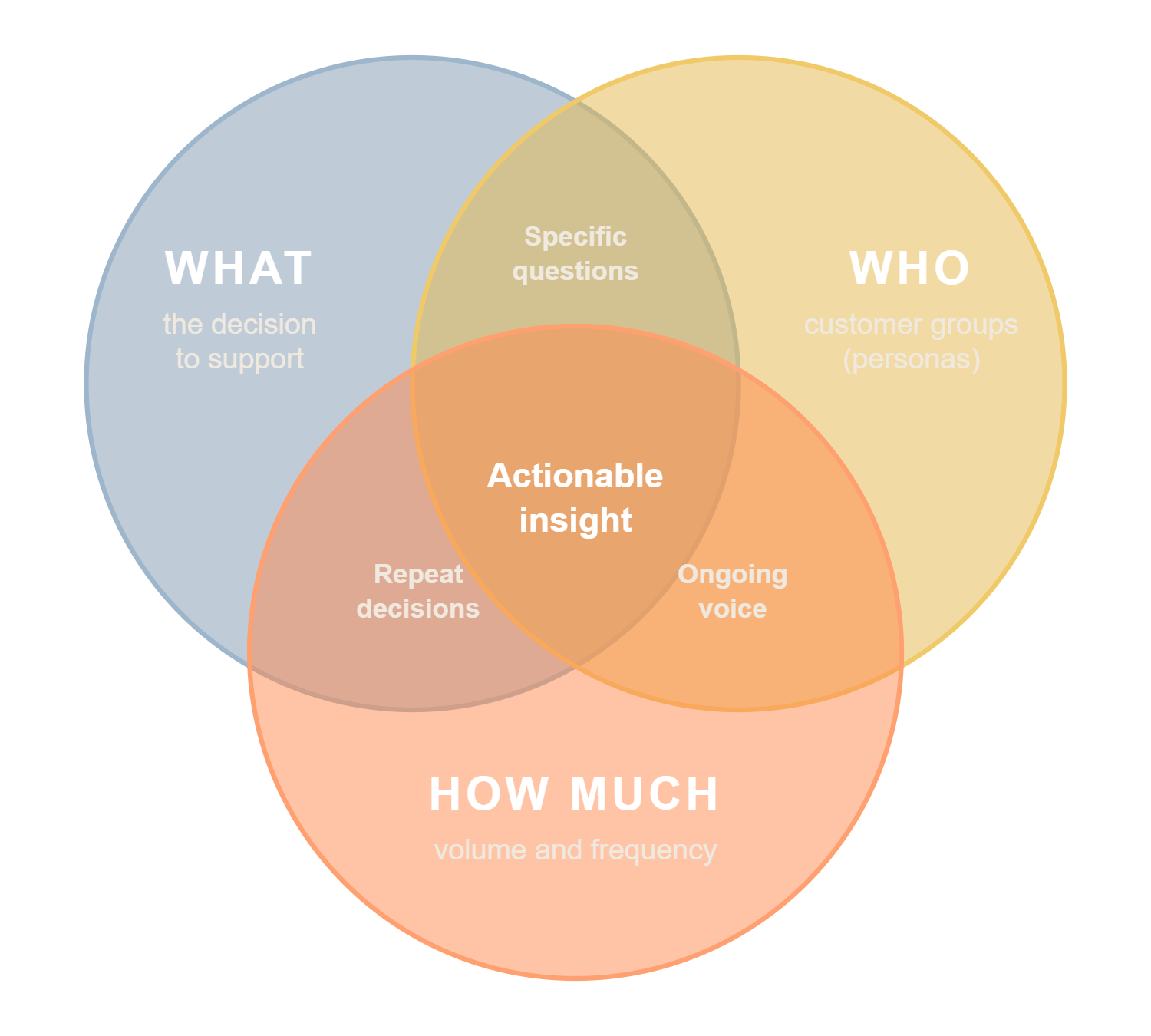
Listening is useful when it answers a decision (what), about the right customer groups (who), at the volume and rhythm you actually face (how much). The three routes below differ in how well they cover that overlap.
Three routes at a glance
A self-service tool you log into.
You have an analyst and need ongoing monitoring of standard questions.
Quick to start and continuous, with a lower cost per month.
It becomes an unread dashboard without a skilled owner. Check that it covers the Thai communities you care about, and try it on your own brand.
A team studies the conversation and delivers findings.
You need a one-off answer or a fresh view.
Expert reading, a clear narrative and recommendations.
It is a snapshot that ages, and it costs again each time. Ask whether the method and sources are explained.
A solution designed around your questions, customer groups and sources.
Your questions or sources are specific, and answers are needed regularly.
Fit to your question, with control over sources and method. Built once, it serves every campaign you run across the year, so the long-term return grows with each use.
It takes the most effort up front and depends on clear requirements. Start with one question, not a big programme.
Four questions that choose the route
1. What do you need the conversation to help you decide?
Start with the goal: avoiding a brand crisis, shaping a campaign or understanding why customers hesitate. A clear goal matters more than any tool, because it tells you what to look for and what to ignore. It also sets the pace: a single launch review suits a report, while early warning suits a tool or a custom build.
Watch out: commissioning a report with no question. A broad “what do people say about us” brief returns a broad answer.
2. Who do you need to hear from?
Customers are not one voice. A first-time buyer, a long-time owner and a former customer talk about different things. Defining these groups as personas turns a broad question into a specific one, and it shows you which conversations are worth reading.
Watch out: treating all customers as one audience, which blurs the signals that matter.
3. How much conversation is there, and how often will you need answers?
Brands launch several campaigns across the year, so listening is rarely a one-off need. A report suits a single moment, while a tool or a custom build keeps working between campaigns. High volume across many Thai communities is also where reading by hand stops working.
Watch out: buying for one campaign what you will need all year. Compare the cost per campaign, not the price of the first one.
4. Who will read and interpret it?
A marketing team, a dedicated analyst or an agency can all do it, and the right choice follows the first three questions, not the other way round. What matters is that someone owns the answer and has the time to read. If nobody does, an agency or a custom solution that delivers findings is more realistic.
Watch out: buying a dashboard with nobody to read it. An unread dashboard is a cost, not insight.
How Balerion helps
Choosing a route is the easy part. Making sure someone understands what customers are saying, at the volume they are saying it, is the hard part.
We have built approaches for enterprise clients that read large volumes of public conversation and turn them into findings the business can act on, together with the data foundations behind them. Our approach follows four stages:
- Frame the decision: agree the one business question and who owns the answer.
- Define who to hear from: set the customer groups, or personas, that matter for that decision.
- Collect, filter and interpret: bring Thai public conversation into one place, remove the noise and group posts by what they say and not how often they appear.
- Assign: deliver findings with named owners, so they become decisions.
Because every brand’s goals, customers and campaigns differ, Balerion can tailor the approach to your brand’s needs.
What decision would you most like customer conversation to support?
Talk to Balerion about a way of listening that fits your decisions, your customers and your campaigns. Email us at talk@balerion.co.th.